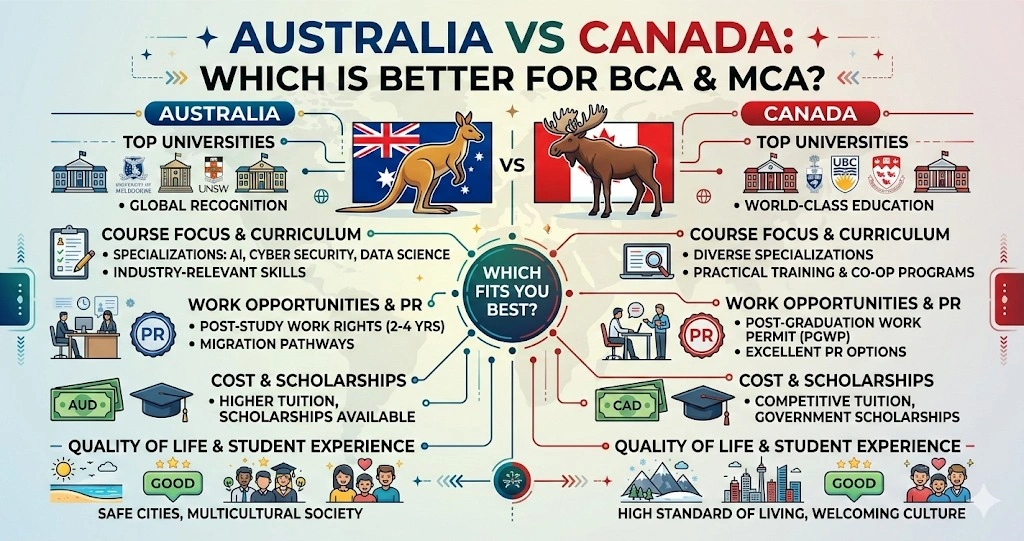
Australia vs Canada for BCA and MCA students: Compare education quality, tuition fees, job opportunities, PR options, and student life to choose the best study destination.
Introduction
Choosing the right country for higher education is one of the most important decisions for students planning to study abroad. For students interested in computer applications, software development, and information technology, two of the most popular study destinations are Australia and Canada.
Both countries offer world-class education systems, modern universities, and excellent career opportunities in the technology sector. Students pursuing degrees similar to BCA (Bachelor of Computer Applications) and MCA (Master of Computer Applications) often consider these two countries because of their strong IT industries and student-friendly immigration policies.
However, deciding between Australia and Canada can be challenging because each country offers unique advantages. Factors such as tuition fees, quality of education, job opportunities, cost of living, post-study work options, and permanent residency pathways all play a crucial role in the decision-making process.
This comprehensive guide compares Australia and Canada across multiple factors to help BCA and MCA students determine which country may be the best choice for their academic and career goals.
Overview of BCA and MCA Programs Abroad
Before comparing countries, it is important to understand how BCA and MCA programs translate internationally.
BCA Equivalent Programs
In most countries, BCA is equivalent to programs such as:
- Bachelor of Computer Science
- Bachelor of Information Technology
- Bachelor of Software Engineering
These undergraduate programs typically last 3 to 4 years.
MCA Equivalent Programs
MCA is generally equivalent to:
- Master of Computer Science
- Master of Information Technology
- Master of Software Engineering
- Master of Data Science
These postgraduate programs usually last 1.5 to 2 years.
Both Australia and Canada offer a wide range of these programs through their universities.
Quality of Education
Both Australia and Canada are known for their high-quality education systems.
Education in Australia
Australian universities are recognized globally for their strong academic standards and research facilities.
Students benefit from:
- Practical learning methods
- Advanced technology labs
- Industry-focused curriculum
Australia emphasizes innovation and digital transformation, making it an attractive destination for technology students.
Education in Canada
Canada also offers an excellent education system with strong emphasis on research and practical learning.
Universities focus on:
- Project-based learning
- Co-op programs with industry experience
- Research and innovation
Canada’s education system is known for being highly student-focused and career-oriented.
Tuition Fees Comparison
Tuition fees are an important factor when choosing between Australia and Canada.
Tuition Fees in Australia
Average annual tuition fees:
Undergraduate IT programs:
$20,000 – $40,000 per year
Postgraduate IT programs:
$22,000 – $45,000 per year
Fees vary depending on the university and program specialization.
Tuition Fees in Canada
Average annual tuition fees:
Undergraduate IT programs:
$15,000 – $30,000 per year
Postgraduate IT programs:
$17,000 – $35,000 per year
Compared to Australia, Canada is generally more affordable for international students.
Cost of Living
The cost of living is another major factor when planning to study abroad.
Cost of Living in Australia
Students typically spend:
$1,400 – $2,500 per month
Major expenses include:
- Accommodation
- Food and groceries
- Transportation
- Health insurance
- Personal expenses
Cities like Sydney and Melbourne are more expensive than smaller cities.
Cost of Living in Canada
Students typically spend:
$1,000 – $2,000 per month
Expenses include:
- Housing
- Food
- Transportation
- Internet and phone
- Health insurance
Overall, Canada tends to have slightly lower living costs than Australia.
Work Opportunities During Studies
Both countries allow international students to work part-time while studying.
Australia
Students can work:
- Up to 48 hours every two weeks during study sessions
- Full-time during holidays
This helps students manage their living expenses and gain work experience.
Canada
Students can work:
- Up to 20 hours per week during academic sessions
- Full-time during scheduled breaks
Canada also offers many on-campus job opportunities for students.
Post-Study Work Opportunities
Post-study work opportunities are extremely important for students pursuing careers in IT and software development.
Post-Study Work in Australia
Graduates may apply for post-study work visas that allow them to stay and work in Australia for several years.
Typical durations:
Bachelor’s degree graduates:
2 – 4 years
Master’s degree graduates:
3 – 5 years
This provides valuable international work experience.
Post-Study Work in Canada
Canada offers a Post-Graduation Work Permit (PGWP).
The PGWP allows graduates to work in Canada for up to 3 years depending on the length of their study program.
This work experience can help students apply for permanent residency later.
IT Industry and Job Opportunities
Both countries have strong technology sectors.
IT Industry in Australia
Australia has a growing technology sector with opportunities in areas such as:
- Software development
- Cybersecurity
- Artificial intelligence
- Cloud computing
- Data science
Major cities like Sydney, Melbourne, and Brisbane offer numerous job opportunities for IT professionals.
IT Industry in Canada
Canada is one of the fastest-growing tech hubs in the world.
Cities known for their technology industries include:
- Toronto
- Vancouver
- Montreal
- Ottawa
Technology companies in Canada are constantly looking for skilled professionals in areas like software engineering, data analytics, and machine learning.
Internship and Co-op Opportunities
Practical experience is crucial for IT students.
Australia
Many Australian universities offer internships and industry placements as part of their programs.
These experiences allow students to gain real-world knowledge and build professional networks.
Canada
Canada is well-known for its co-op education programs.
Co-op programs combine academic study with paid work placements.
Benefits include:
- Professional experience
- Higher employability after graduation
- Industry connections
For IT students, co-op programs can be extremely valuable.
Immigration and Permanent Residency
Many international students choose countries that offer opportunities to stay permanently.
Permanent Residency in Australia
Australia offers several pathways for skilled workers.
Graduates in technology-related fields may qualify for skilled migration programs.
However, immigration policies can change and may require specific work experience and skill assessments.
Permanent Residency in Canada
Canada is widely considered one of the most immigration-friendly countries.
International graduates may apply for permanent residency through programs such as:
- Express Entry
- Provincial Nominee Programs
Work experience gained through the Post-Graduation Work Permit can improve eligibility for permanent residency.
Student Lifestyle and Environment
Life in Australia
Australia offers:
- Beautiful beaches
- Warm climate
- Vibrant cities
- Outdoor lifestyle
Students enjoy a relaxed and active lifestyle.
Life in Canada
Canada offers:
- Multicultural cities
- Safe communities
- Beautiful natural landscapes
- Diverse cultural experiences
However, winters can be very cold in some regions.
Safety and Quality of Life
Both Australia and Canada are considered safe countries for international students.
They offer:
- Stable political systems
- Strong healthcare services
- High living standards
Students generally feel comfortable and secure in both countries.
Scholarships for IT Students
Both countries offer scholarships for international students pursuing technology programs.
Types of scholarships include:
- Merit-based scholarships
- Government-funded scholarships
- University scholarships
- Research grants
These financial aids help reduce tuition costs and make studying abroad more affordable.
Which Country Is Better for BCA Students?
For undergraduate students:
Canada may be a better option because:
- Lower tuition fees
- Co-op programs
- Strong tech job market
- Easier PR pathways
However, Australia also provides excellent education and vibrant student life.
Which Country Is Better for MCA Students?
For postgraduate students:
Both countries offer strong master’s programs.
Canada may have advantages such as:
- More tech job opportunities
- Better immigration pathways
- Strong startup ecosystem
Australia may appeal to students who prefer warmer climate and global universities.
Final Comparison
Choose Australia if you prefer:
- Warm climate
- Strong universities
- International lifestyle
- Growing tech sector
Choose Canada if you prefer:
- Lower tuition costs
- Co-op education programs
- Strong IT job market
- Easier permanent residency options
Conclusion
Both Australia and Canada offer excellent opportunities for students pursuing BCA and MCA equivalent programs in computer science and information technology.
Australia provides world-class universities, innovative teaching methods, and a vibrant lifestyle. Canada offers affordable education, strong industry connections, and immigration pathways for international graduates.
Ultimately, the best choice depends on individual goals, financial situation, and career plans. Students who carefully evaluate tuition costs, job opportunities, and long-term immigration prospects can make an informed decision.
By choosing the right destination, BCA and MCA students can gain valuable international education, develop advanced technical skills, and build successful global careers in the technology industry.
FAQs
1. Is Canada better than Australia for BCA students?
Canada is often considered more affordable and offers strong co-op programs, making it attractive for BCA-equivalent programs.
2. Which country has better IT job opportunities?
Both countries have strong IT industries, but Canada currently has a rapidly growing technology sector with many job opportunities.
3. Can students work while studying in Australia or Canada?
Yes, both countries allow international students to work part-time during their studies.
4. Which country offers easier permanent residency?
Canada generally offers more straightforward immigration pathways for international graduates.
5. Are scholarships available for IT students in these countries?
Yes, both Australia and Canada provide scholarships for international students studying technology programs.
6. Which country has a lower cost of living?
Canada usually has slightly lower living costs compared to Australia, depending on the city.