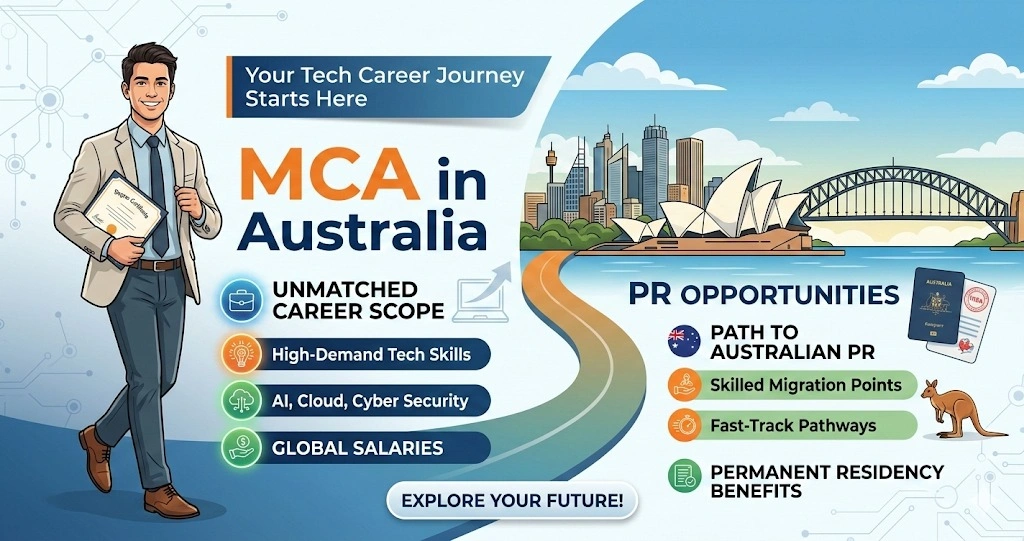
Explore MCA in Australia including tuition fees, scholarships, career opportunities, salary expectations, and PR pathways for international students in this complete 2026 guide.
Introduction
Australia has become one of the most popular destinations for international students who want to pursue higher education in technology and computer science. With its world-class universities, advanced research facilities, strong technology sector, and welcoming immigration policies, Australia attracts thousands of international students every year.
Among the many technology-related programs available, a Master of Computer Applications (MCA) or equivalent postgraduate IT degree is highly valued in Australia. Students who want to build careers in software development, data science, cybersecurity, artificial intelligence, and cloud computing often choose this field because of its strong job prospects and high earning potential.
One of the biggest reasons international students choose Australia for MCA or IT-related postgraduate programs is the possibility of long-term career growth and permanent residency (PR). Australia has a high demand for skilled IT professionals, and many technology occupations are listed under the country’s skilled migration program.
This comprehensive guide explains everything you need to know about studying MCA in Australia, including universities, eligibility requirements, tuition fees, scholarships, career opportunities, salary expectations, and pathways to permanent residency.
What is MCA and Its Equivalent in Australia?
MCA stands for Master of Computer Applications, a postgraduate degree focused on computer science, software development, and information technology.
While the exact degree title “MCA” is not commonly used in Australian universities, the equivalent programs include:
- Master of Information Technology
- Master of Computer Science
- Master of Software Engineering
- Master of Data Science
- Master of Cybersecurity
These programs offer similar coursework and career opportunities as an MCA degree.
Students from countries like India who complete a Bachelor of Computer Applications (BCA) or similar undergraduate program can easily apply for these postgraduate IT degrees in Australia.
Why Study MCA in Australia?
Australia offers several advantages for international students pursuing postgraduate IT education.
Globally Recognized Universities
Australian universities are recognized worldwide for their academic excellence and research contributions. Graduates from Australian institutions often receive strong recognition in global job markets.
High Demand for IT Professionals
The technology industry in Australia continues to grow rapidly. Companies constantly look for skilled professionals in software development, data analysis, cybersecurity, and artificial intelligence.
Industry-Oriented Curriculum
Australian IT programs focus on practical learning, industry projects, internships, and real-world applications. This approach prepares students for professional roles immediately after graduation.
Post-Study Work Opportunities
International students can apply for post-study work visas after completing their degrees. This allows them to gain valuable work experience in Australia.
Pathway to Permanent Residency
Many IT professions are listed on Australia’s Skilled Occupation List, making it easier for qualified graduates to apply for permanent residency.
Top Universities in Australia for IT and MCA Equivalent Programs
Several universities in Australia offer high-quality postgraduate programs in computer science and information technology.
Some well-known institutions include:
- University of Melbourne
- University of Sydney
- Australian National University
- Monash University
- University of Queensland
- University of New South Wales
- RMIT University
- Deakin University
- University of Technology Sydney
These universities provide advanced IT programs with strong industry partnerships and research opportunities.
Eligibility Requirements for MCA in Australia
International students must meet certain academic and language requirements to apply for postgraduate IT programs.
Academic Requirements
Students typically need:
- A bachelor’s degree in computer science, IT, BCA, or related field
- Good academic performance (usually equivalent to 60–70% or higher)
Some universities may accept students from non-IT backgrounds through bridge programs.
English Language Requirements
Since courses are taught in English, students must prove their English proficiency.
Commonly accepted exams include:
- IELTS
- TOEFL
- PTE Academic
Most universities require an IELTS score of around 6.5 overall with no band lower than 6.0.
Additional Requirements
Some programs may also require:
- Statement of purpose
- Letters of recommendation
- Resume or CV
- Work experience (optional but beneficial)
Duration of MCA Equivalent Programs in Australia
Postgraduate IT programs in Australia generally take:
1.5 to 2 years to complete depending on the university and course structure.
Programs usually include:
- Core subjects
- Elective subjects
- Capstone projects
- Industry internships
These components help students gain practical knowledge and industry exposure.
Tuition Fees for MCA in Australia
The cost of studying in Australia varies depending on the university and program.
Average annual tuition fees for IT postgraduate programs range from:
AUD 30,000 to AUD 50,000 per year
Total course cost may range between:
AUD 45,000 to AUD 100,000 for the full program.
Although the cost may seem high, scholarships and part-time work opportunities help reduce financial pressure.
Scholarships for MCA Students in Australia
Many scholarships are available for international students pursuing postgraduate IT programs.
Government Scholarships
The Australian government offers scholarships for talented international students to study in Australian universities.
These scholarships may cover tuition fees, travel costs, and living expenses.
University Scholarships
Many universities provide merit-based scholarships for international students based on academic performance.
These scholarships may offer partial tuition fee reductions.
Industry-Sponsored Scholarships
Technology companies and private organizations sometimes sponsor students studying computer science or IT-related programs.
Cost of Living in Australia
In addition to tuition fees, students must consider living expenses.
Average living costs in Australia range from:
AUD 20,000 to AUD 27,000 per year
Typical expenses include:
- Accommodation
- Food and groceries
- Transportation
- Health insurance
- Internet and utilities
Living costs may vary depending on the city.
Major cities like Sydney and Melbourne are more expensive than smaller cities.
Part-Time Work Opportunities
International students in Australia are allowed to work while studying.
Students can work:
Up to 48 hours per fortnight during academic sessions
and
Unlimited hours during semester breaks
Part-time jobs help students gain work experience and support their living expenses.
Common student jobs include:
- Retail assistant
- Restaurant staff
- Customer service representative
- Administrative assistant
- IT support roles
Career Scope After MCA in Australia
The demand for IT professionals in Australia is very strong. Graduates with advanced IT degrees can find opportunities across multiple industries.
Software Developer
Software developers design and build applications, websites, and enterprise systems.
Average salary:
AUD 80,000 – AUD 120,000 per year
Data Scientist
Data scientists analyze large datasets to help organizations make data-driven decisions.
Average salary:
AUD 90,000 – AUD 130,000 per year
Cybersecurity Specialist
Cybersecurity experts protect organizations from cyber threats and security breaches.
Average salary:
AUD 100,000 – AUD 140,000 per year
Cloud Engineer
Cloud engineers manage cloud infrastructure and services for businesses.
Average salary:
AUD 95,000 – AUD 135,000 per year
Artificial Intelligence Engineer
AI specialists develop intelligent systems using machine learning and automation.
Average salary:
AUD 110,000 – AUD 150,000 per year
Industries Hiring IT Graduates in Australia
Many industries hire IT professionals, including:
- Technology companies
- Banking and finance
- Healthcare
- Telecommunications
- Government agencies
- E-commerce companies
- Startups and software firms
Australia’s growing digital economy continues to create new technology jobs.
Post-Study Work Visa in Australia
International students who complete postgraduate degrees in Australia can apply for a post-study work visa.
This visa allows graduates to stay and work in Australia after completing their degree.
The typical duration for master’s graduates is:
2 to 3 years depending on the qualification and location.
This work experience is valuable for career growth and immigration pathways.
Permanent Residency (PR) Opportunities
Australia offers skilled migration pathways for qualified professionals.
Many IT occupations appear on the Skilled Occupation List (SOL).
Some common IT occupations include:
- Software Engineer
- ICT Business Analyst
- Systems Analyst
- Developer Programmer
- Cybersecurity Specialist
- Data Scientist
Graduates who gain relevant work experience can apply for permanent residency through skilled migration programs.
Steps to Apply for MCA in Australia
Students planning to study in Australia should follow these steps:
Step 1: Choose a University and Program
Research universities offering IT or computer science postgraduate programs.
Step 2: Check Eligibility Requirements
Ensure you meet academic and English language requirements.
Step 3: Prepare Required Documents
Common documents include:
- Academic transcripts
- English test scores
- Statement of purpose
- Passport copy
- Resume or CV
Step 4: Apply to Universities
Submit online applications through university portals.
Step 5: Receive Offer Letter
Once accepted, universities issue an offer letter.
Step 6: Apply for Student Visa
Students must apply for an Australian student visa to begin their studies.
Tips for International Students
Students planning to study MCA in Australia should consider these tips:
- Start preparing at least one year in advance
- Research scholarship opportunities
- Improve English language skills
- Gain basic programming knowledge
- Build a strong academic profile
Proper planning increases the chances of admission and scholarships.
Conclusion
Australia is an excellent destination for international students pursuing MCA or equivalent postgraduate IT programs. The country offers high-quality education, globally recognized universities, and strong connections between academia and industry.
Graduates from Australian IT programs benefit from high employability, competitive salaries, and opportunities to work in cutting-edge technology fields such as artificial intelligence, data science, cybersecurity, and cloud computing.
In addition to career advantages, Australia also offers clear pathways for post-study work visas and skilled migration, making it an attractive option for students who want to build long-term careers abroad.
With the right preparation, strong academic performance, and determination, studying MCA in Australia can open doors to global career opportunities and a successful future in the technology industry.
FAQs
1. Is MCA available in Australia?
Australian universities usually offer equivalent degrees such as Master of Information Technology, Master of Computer Science, or Master of Software Engineering.
2. Can BCA students apply for MCA in Australia?
Yes, students who have completed a BCA or related degree can apply for postgraduate IT programs in Australia.
3. How much does MCA cost in Australia?
Tuition fees generally range between AUD 30,000 and AUD 50,000 per year depending on the university.
4. Can MCA graduates get PR in Australia?
Yes, many IT professions are listed on Australia’s Skilled Occupation List, which can lead to permanent residency pathways.
5. Can international students work while studying in Australia?
Yes, international students can work part-time during their studies and full-time during semester breaks.